 Long Island

For many women, the first sign is not on the scalp at all. It shows up in the mirror as thinner eyebrows, a favorite brow pencil suddenly doing more work than it used to, or a photo from a few years back that looks fuller than the reflection does today. By the time the hairline itself starts to change, usually a slow, even retreat across the front and sides rather than a widening part, the pattern has often been underway for a while.
This pattern has a name: frontal fibrosing alopecia (FFA), a scarring form of hair loss that behaves differently from ordinary thinning and calls for a different kind of evaluation. It belongs to the same family of conditions covered in our guide to cicatricial, or scarring, alopecia, and understanding what is actually happening underneath the hairline and eyebrow changes, not just the pattern itself, is the starting point for any conversation about hair restoration.
A Scarring Form of Hair Loss That Starts at the Hairline
Most hair loss changes the volume of what is already there. Frontal fibrosing alopecia changes the boundary itself. It is classified as a cicatricial, or scarring, alopecia, which means the inflammation involved does not just slow a follicle down, it can destroy the structure that regenerates hair altogether. Once that structure is gone, the skin over it heals smooth and the follicle opening disappears along with it. That distinction, hair that has temporarily stopped growing versus a follicle that no longer exists, is the reason this condition is evaluated with more urgency than typical pattern hair loss.
In practice, this usually shows up as a band of recession along the front and sides of the scalp, tracking backward in a fairly even line rather than the irregular, patchy pattern seen in some other types of hair loss. The skin in the affected band often looks slightly pale or shiny compared to the scalp around it, sometimes with mild redness or small, skin-colored bumps near the hairline during the active stage.
It is also worth separating this condition from ordinary hairline maturation or styling-related breakage along the temples, both of which are common and unrelated to any scarring process. The clue that points toward frontal fibrosing alopecia specifically, rather than either of those more benign explanations, is the combination: a genuinely receding hairline band, some loss of texture or shine in the surrounding skin, and eyebrow changes happening around the same general period.
For men, the pattern can be harder to recognize early, since a receding hairline is already expected with age and is easy to attribute to ordinary male pattern hair loss. A dermatologist looking specifically for frontal fibrosing alopecia will check for the same combination of signs described above, along with any sideburn thinning, which is a less common but recognized presentation in men with the condition.
Why the Hairline and Eyebrows Are Usually Affected First
Eyebrow thinning frequently shows up before the hairline changes become obvious, sometimes by months or longer, which is part of why the condition often gets caught later than it could be. Between 80% and 95% of women diagnosed with FFA lose some or all of their eyebrows at some point, and eyelash or body hair can be affected too in more extensive cases. Anyone noticing unexplained eyebrow thinning alongside a receding hairline, especially without an obvious cause like over-plucking or a known skin condition, has good reason to bring up frontal fibrosing alopecia by name at a dermatology visit rather than assuming it is routine thinning.
Is Frontal Fibrosing Alopecia the Same as Lichen Planopilaris?
Frontal fibrosing alopecia has long been considered a variant of lichen planopilaris, since the two conditions look nearly identical on biopsy and share the same underlying immune process. Some dermatologists treat them as points on the same spectrum rather than separate diagnoses, distinguished mainly by where the pattern shows up: the hairline and eyebrows for frontal fibrosing alopecia, versus the crown and scattered patches for classic lichen planopilaris. Not every expert agrees the two are identical, and there are real differences in how each tends to behave, but the overlap matters practically. Treatment approaches for one are often drawn from research on the other, since large studies of either disease individually are hard to come by.
What Causes Frontal Fibrosing Alopecia?
No single cause has been confirmed, which is part of what makes the condition frustrating to explain to patients. A 2019 genome-wide association study identified genetic susceptibility loci for the condition, which supports a real hereditary component, something also suggested by how often cases run in families. Hormonal factors are widely suspected as well. The condition affects women who have gone through menopause far more often than any other group, which points toward an androgen-related mechanism, though the exact pathway is not settled.
An autoimmune process is also part of the picture: the disease is more common in people who already have conditions like an underactive thyroid, lupus, or rheumatoid arthritis, and a small number of studies have pointed to certain facial skincare products and sunscreens as possible triggers or accelerants rather than root causes. In short, this looks like a condition where a genetic predisposition needs a hormonal or environmental trigger to become active, not a single-cause disease.
Does It Keep Progressing, or Can It Stop on Its Own?
The course varies a lot from person to person, which is part of why an early evaluation matters. In many cases the condition advances slowly over a period of years and then quiets down on its own, leaving a stable, fixed area of hairline recession rather than continuing indefinitely. In other cases, it moves faster and covers more ground before it settles. What it does not do is reverse itself: hair does not grow back in an area where the follicle has already scarred over, which is why the practical goal of treatment is almost always to stop the process from advancing further, not to regrow what is already gone. That framing, protecting what remains rather than chasing what is lost, is the same one dermatologists use for lichen planopilaris and other scarring alopecias, and it is worth adjusting expectations around before the first appointment.
How the Diagnosis Is Made
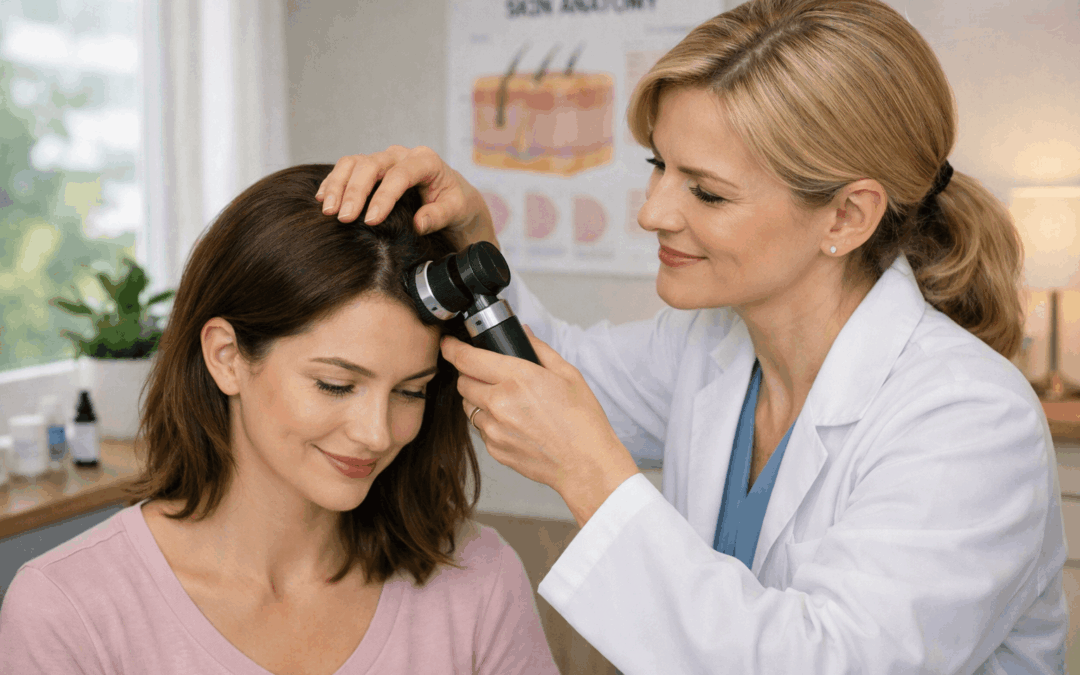
A dermatologist typically starts with a close visual and dermoscopic exam of the hairline and eyebrows, looking for the pattern’s characteristic signs: loss of visible follicle openings, fine scale around the remaining hairs, and sometimes small, skin-colored bumps along the advancing edge. Because the clinical picture can resemble other types of hair loss, a small scalp biopsy is often used to confirm the diagnosis and rule out other scarring or non-scarring conditions, particularly when the presentation is not textbook. Bloodwork to check thyroid function is common as well, given how often the two conditions occur together.
None of this is something to piece together from photos or a mirror at home. The visual signs of frontal fibrosing alopecia overlap enough with traction alopecia, ordinary hairline maturation, and even some non-scarring conditions that a confident diagnosis really does depend on an in-person exam, and often the biopsy. Getting that diagnosis early matters more here than with most types of hair loss, since the window during which a follicle can still be protected closes once scarring sets in.
What a Hair Restoration Consultation Should Actually Cover
Because frontal fibrosing alopecia is a dermatology-led diagnosis, LA FUE Hair New York does not diagnose or manage the underlying disease itself. A hair loss evaluation for this condition, whether in Manhattan or on Long Island, should start with confirming that a dermatologist has already made the diagnosis and is tracking whether it is currently active or stable, not with a discussion of grafts or pricing.
From there, a meaningful hair transplant candidacy conversation looks at where the hairline sits now, how much of the surrounding skin is scarred versus still viable, and what the dermatologist’s documented disease-activity history shows. Anyone who has not yet seen a dermatologist about a suspected case should do that first. The sequence matters: dermatology confirms and stabilizes the disease, and only then does it make sense to talk about whether restoring the appearance of the hairline is realistic.
It also helps to walk in with a few specifics rather than just a general concern: roughly when the changes were first noticed, whether a dermatologist has already been seen and what that visit found, any medications currently being used to manage the condition, and any family history of similar hair loss. None of that is required to schedule a first conversation, but it shortens the distance between that conversation and a genuinely useful answer about candidacy.
Where Hair Restoration Fits In
The honest answer is that hair restoration is not a first step for frontal fibrosing alopecia, and for some people it may not be an appropriate step at all. Hair grafting may be considered once disease activity has settled, and most surgeons want that stability documented by the treating dermatologist over an extended period, not just a good few weeks, before evaluating candidacy. Even then, treatment is generally described as something that can occasionally help restore the hairline’s appearance if the condition has been stable, and results can be less predictable than a standard procedure for pattern hair loss, since the treated area still carries some risk of being affected if the underlying disease reactivates.
What About Eyebrows?
Eyebrows lost to frontal fibrosing alopecia can sometimes be addressed using the same restoration principles once they, too, are confirmed stable by a dermatologist. That said, it is a separate conversation from scalp restoration, evaluated on its own, and how much of the underlying brow structure remains has a real effect on what is realistic to expect.
When You’re Ready, LA FUE NYC Is Here For You
At LA FUE Hair New York, Dr. Anton Georgiev approaches a suspected or diagnosed case of frontal fibrosing alopecia the way he approaches any consultation involving an active medical condition: by establishing what is actually happening on the scalp, and by whom it is being managed, before any conversation about a hair restoration procedure takes place. For some patients, that means confirming stability and moving forward. For others, it means coordinating with a dermatologist first and revisiting the question later, which is often exactly the right sequence rather than a delay. Consultations are available at both our Garden City and Manhattan offices. Schedule a consultation when you are ready to talk through where things stand.
If this was useful, tell Google you want more of it.